New England Nova
Saving Grace
Saving Grace
Couldn't load pickup availability
The Mayflower was sixty-five days into the Atlantic when the storm hit.
The waves were violent enough to crack one of the massive wooden beams holding the ship together. One hundred and two passengers. Sixty-six crew. An ocean between them and everything they had left behind — and now, a ship that might not hold.
And then someone remembered the screw.
A great iron screw, packed almost as an afterthought, was used to raise the beam back into place. The ship held. The voyage continued. Who thought to bring it? History doesn't say. But someone did — and that quiet act of foresight saved every soul aboard.
Around the same time, a young passenger named John Howland was swept off the deck and into the freezing Atlantic. He grabbed a trailing rope, was hauled back aboard, and went on to become one of the most-descended Mayflower passengers in American history. Millions of Americans trace their lineage to the man who should not have survived.
A screw. A rope. Two moments of grace so unlikely they could only be called what they were.
Saving grace.
The Stones
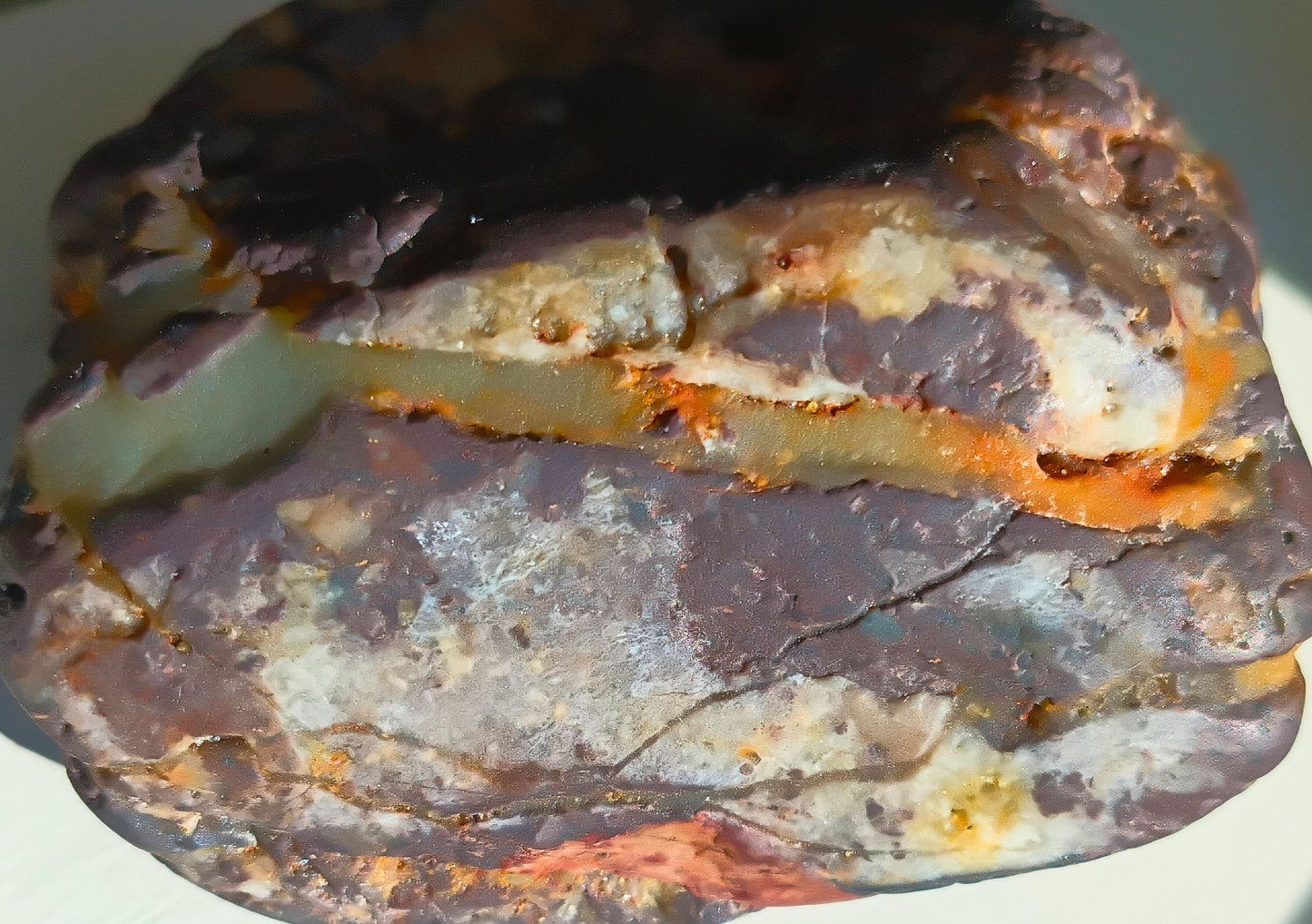
These are not ordinary beach finds. This specimen is almost certainly Roxbury Conglomerate — New England's own puddingstone, and the official state rock of Massachusetts — but it goes further than most.
The warm buff and amber matrix is likely a jasper and chert-rich groundmass, compressed and iron-stained over time into something that glows amber and rust in sunlight. Pressed into it are rounded clasts of purple-grey quartzite or volcanic material — harder stones that were already ancient when they became part of this one.
But it's the surface that sets this stone apart. Those raised, lumpy, almost grape-cluster protrusions aren't typical of plain puddingstone. They suggest the presence of manganese oxide nodules forming in botryoidal habit — a rare and striking feature that gives this stone its almost sculptural, otherworldly texture. Deep iron-oxide veining bleeds orange through the fractures. Every face reads differently: rugged and raw from one angle, luminous from another.
This is the kind of specimen that resists easy explanation — and rewards a closer look every time.
The companion piece is its own mystery — a dense, striated stone with a natural helical texture that looks like something carved rather than formed. Whether it's a fossil cast, a stress fracture pattern, or something rarer, it resists easy explanation. It's the kind of stone you show people and watch them reach for it.
Display them together on a mantel, a shelf, or a raw wood surface. These are statement specimens — the kind that anchor a room and start conversations. And if you've ever wanted to cut a stone and see what's inside, the puddingstone is a serious candidate — polished, the contrast between matrix and clasts becomes extraordinary.
Hand-collected from Plymouth, Massachusetts. Never tumbled. Never treated. Each set is one of a kind.
What's Included
- 1 large puddingstone specimen
- 1 striated companion stone
- Total set weight: approx. 0.8 lbs
Share