He didn’t start out angry. He started out broke.
When Samuel Adams was a young man, the British government destroyed his family. His father had helped found the Land Bank — a lifeline for poor farmers and struggling Boston merchants. Parliament outlawed it. The debts fell on his family. For years, Adams fought off government agents trying to seize his father’s land.
That injustice never left him.
Born in Boston in 1722, the son of a brewer, Adams became the most dangerous man in New England — not with a musket, but with words. He organized the Sons of Liberty. He kept the memory of the Boston Massacre alive when others wanted to move on. He united the colonies through letters when they had no other voice.
In 1773, Parliament passed the Tea Act, granting the East India Company a monopoly on tea sold in the colonies. To make it worse, two of the hand-picked merchants chosen to sell that tea in Boston were the sons of Royal Governor Thomas Hutchinson. The colonies had no say. No vote. No representation. Three ships arrived at Griffin’s Wharf loaded with 342 chests of East India Company tea — and according to customs law, they had twenty days to unload.
Samuel Adams spent those twenty days exhausting every legal option. He negotiated with ship owners. He appealed to customs officials. He ordered the ships to turn back to London. The British warships in the harbor refused to let them leave. On December 16, 1773, thousands of angry Bostonians packed into Old South Meeting House for one final appeal. Francis Rotch rode to Milton to beg Governor Hutchinson for permission to send the ships home. Hutchinson refused.
Samuel Adams rose from his pew.
“This meeting can do nothing more to save the country.”
342 chests of tea hit the harbor that night.
About These Stones
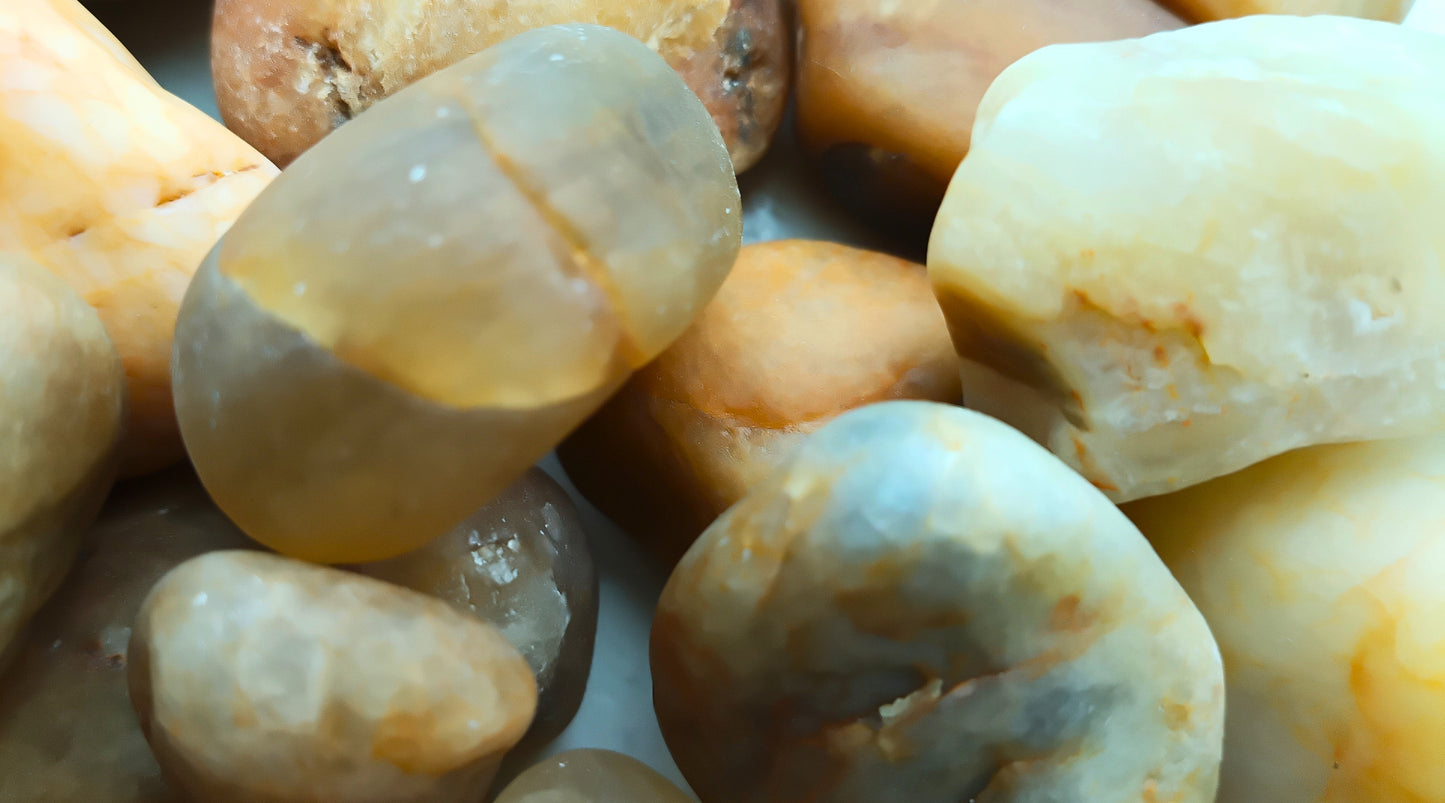
These stones glow. Pulled from the shores of Plymouth, Massachusetts, each one carries warm honey-gold and amber, streaked with cream and white — some so translucent they catch the light like sea glass. Smooth and waxy to the touch. Heavy in the hand. The kind of stone you pick up and don’t put down.
Look closely and you’ll find one that stops you — deep amber fading to a dark, smoldering tip, blue-grey and spent. It looks exactly like a match just struck. Or a fire just started. Fitting, for a man whose words were the spark that lit a revolution.
This set contains 62 stones — one for every year of Samuel Adams’ life when the Constitution was ratified in 1788. He had spent decades fighting for it. He lived to see it done.
The stones in this collection are likely a mix of the following:
-
Honey-gold to amber — likely chert or flint, semi-translucent and waxy, with that characteristic glow when held to the light. Flint was essential to early New England — the Pilgrims and the Wampanoag both depended on it to make fire. It sparked then. It still looks like it could.
-
Cream and white with orange veining — likely chalcedony or quartz, with iron oxide bleeding through natural fractures like a map drawn in rust and flame.
-
Dark blue-grey patches — likely basalt or fine-grained chert inclusions, the smoldering contrast against the warm amber — shadow and fire in a single stone.
-
The cracked interior — where the surface has broken open, you can see the layered, waxy interior of what is likely agate or chert — formed slowly, under pressure, over time.
Not polished. Not treated. What you see is exactly what the waves delivered.
Hand-collected from America’s Hometown, Plymouth, Massachusetts. Never tumbled. Never treated. Each set is one of a kind.
Born here. Brewed here. Unbreakable.