New England Nova
Massasoit & Winslow
Massasoit & Winslow
Couldn't load pickup availability
Massasoit was the chief of the Wampanoag tribe upon the arrival of the Pilgrims to Plymouth, MA in 1620.
On March 22, 1620 - Massasoit paid his first visit to the Plymouth Plantation
Edward Winslow, who would become governor of the colony first in 1633, was sent out to meet him with some knives and a copper jewel chain as gifts. Winslow told Massasoit that the Pilgrims desired peace and trading and that Kings James of England saluted him with peace and love, and accepted him as an ally and friend.
Massasoit was pleased and willingly agreed to the negotiations.
But three years into that peace treaty, Massasoit was at a camp in Rhode Island; he had the plague and he was dying.
When Winslow discovered the news, he put some herbs together and walked over forty miles of wilderness to reach Massasoit with the remedy to nurse him back to health.
Halfway there, he was met on a path by a native American who told him not to bother finishing the trip because Massasoit had already died.
He finished the trip anyway and discovered that Massasoit had not yet died but was very close. Winslow nursed him back to health.
From then on they became even greater friends, and the peace treaty grew stronger than ever before.
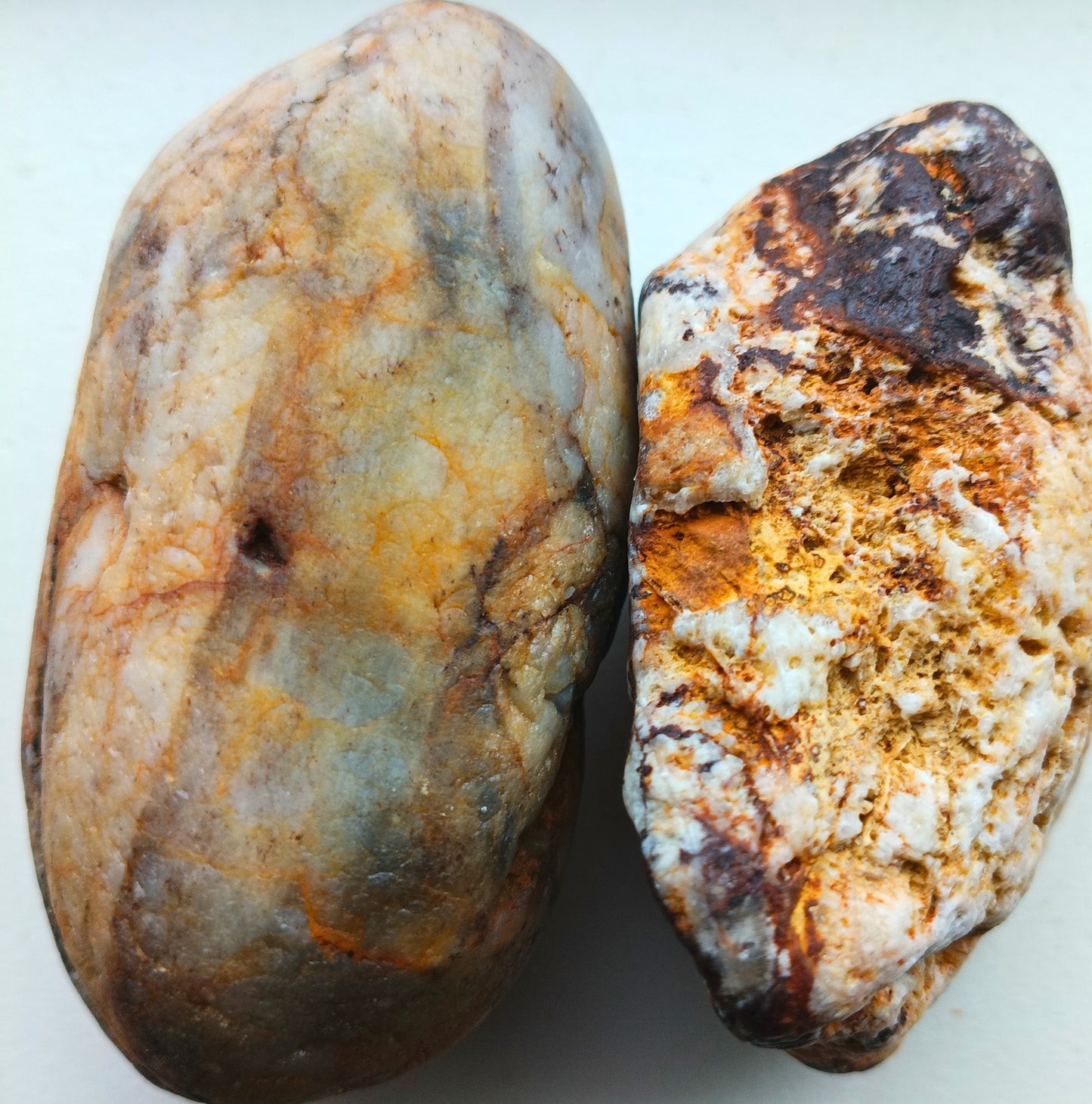
These two stones come from the shores of Plymouth, where that story began.
These two stones come from the shores of America’s Hometown — Plymouth, Massachusetts — where that story began. Complimentary in color, different in texture & weight, shaped and shore delivered by the same sea. Raw patterns resembling the natural earthly provisions, given by God that sustained them both. A friendship built on the willingness to walk the deep forests or cross mountains to reach a friend in need.
There for each other. As they were meant to be.
The Stones Themselves
These are not small. Bigger than a palm, substantial in the hand, with the kind of weight that anchors a room. Each one is a raw New England find — the kind of stone that stops you on a beach and doesn’t let you walk away.
One carries the smooth, flowing veins of banded gneiss — cream and warm amber marbled through with dark chocolate and near-black, like something carved by an artist who had ten thousand years to work. The other is rougher, more rugged — a coarse-grained granite or pegmatite dusted in iron-rust orange and gold, with dark biotite and hornblende pressed through like embers in stone. Together they are complementary opposites: one refined, one raw.
Display them on a mantel. Set them on a porch with dark river rocks for a farmhouse or western chic aesthetic. Give them as a pair to someone who understands that the best things come from the earth. Or cut one open ;)
These are statement pieces. They just happen to remind us of one of New England’s greatest stories of friendship and service.
“Greater love has no one than this: to lay down one’s life for one’s friends.” — John 15:13
Share