"When you pass through the waters, I will be with you; and through the rivers, they shall not overwhelm you."
— Isaiah 43:2
In September of 1620, young woman named Susanna White boarded the Mayflower with her husband William, her young son Resolved, and a blessing she was carrying across the Atlantic.
She was 8 1/2 months pregnant with a baby boy.
For sixty-six days she endured what no pregnancy book has ever prepared anyone for — the relentless heaving of a wooden ship on the open ocean, the smell of 130 people in an enclosed space with no ventilation, no privacy, no comfort, no warmth. Seasickness so severe that grown men wept. Storms violent enough to crack the ship's beams. Darkness below deck that never quite lifted.
And through all of it, she hung on. She endured. She could not turn back.
In late November 1620, while the Mayflower sat anchored off the tip of Cape Cod — Susanna gave birth to their son. They named him Peregrine. The Latin word for pilgrim. The first English child born in New England, delivered on a rocking ship in freezing November, before his mother had ever set foot on the shore she'd crossed an ocean to reach.
That winter, William died at age 31.
Susanna survived. One of only four adult women to live to see the First Thanksgiving that autumn. She went on to remarry — Edward Winslow, in the first marriage at Plymouth Colony — and to build a life from the wreckage of everything she had lost.
She was carried safely through the storm.
If you have ever white-knuckled your way through something that felt impossible — a pregnancy, a loss, a crossing you didn't choose — these stones are for you.
The Stones
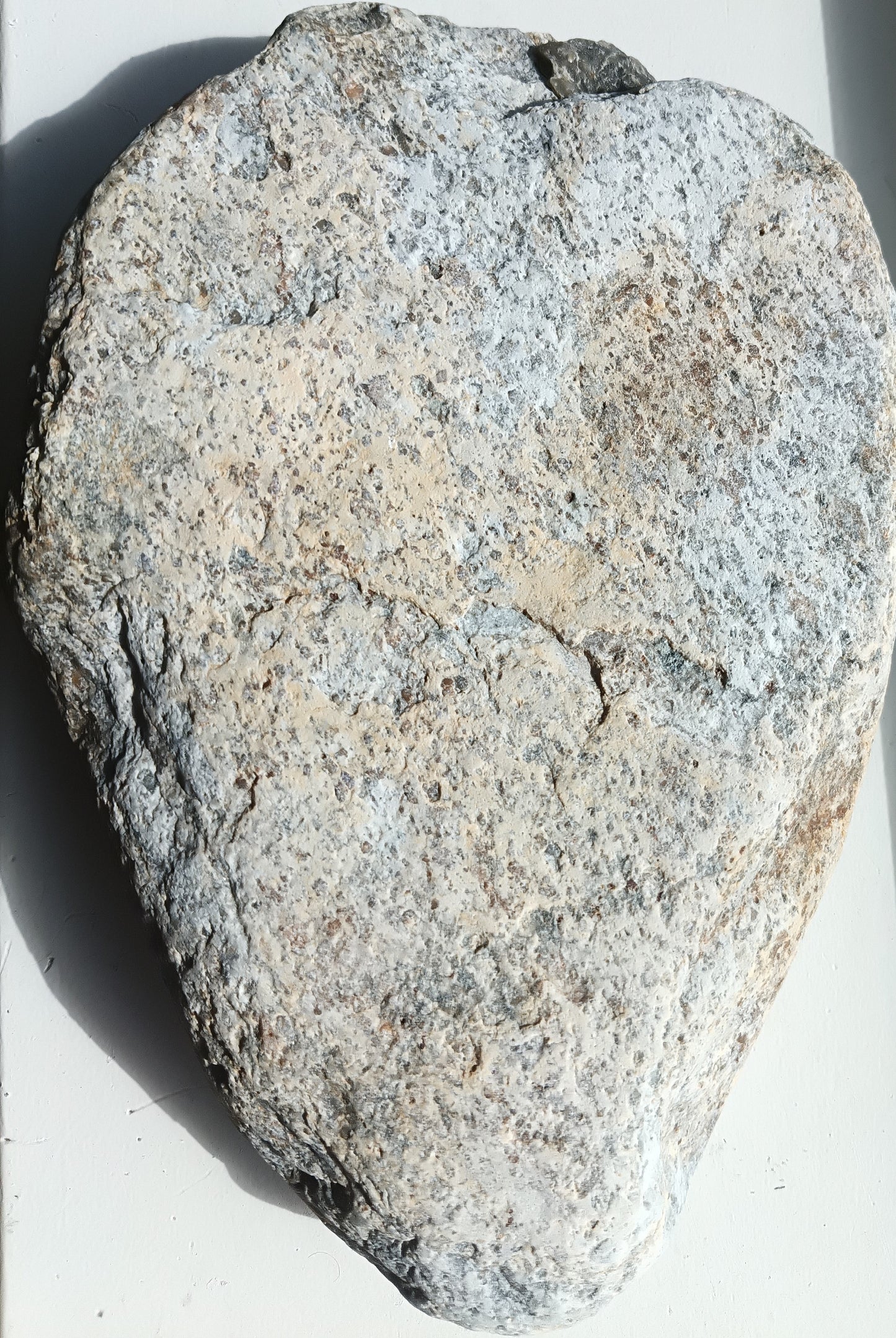
This set includes five stones, each hand-collected from the shores of Plymouth, Massachusetts — the same coastline the Pilgrims first saw from the deck of the Mayflower.
What you'll find in your set:
-
Dark blue-black stones with cream or rust intrusions — likely a metamorphic schist or phyllite, formed under intense heat and pressure deep within the earth. The light-colored veins are quartz or feldspar that forced their way through fractures over millions of years. Pressure made visible.
-
Banded or layered stones — sedimentary in origin, these show the slow accumulation of time itself: sand, silt, and mineral deposits compressed into stripes. Each band is a chapter.
-
Pale blue-grey stones with speckled patterns — likely granite or a granitic gneiss, the bedrock of coastal New England. Formed from cooled magma, they are among the oldest rocks you will ever hold.
-
Rough-textured stones with exposed interior — where the outer surface has broken away, revealing the raw mineral structure within. Unpolished. Unguarded. Exactly as found.
-
A broad, flat base stone — the anchor of the set. Something to rest the others on.
None of these stones have been tumbled, dyed, or treated. What you see is exactly what the sea and centuries made them.
Hand-collected from Plymouth, Massachusetts. Never tumbled. Never treated. Each set is one of a kind.
What's Included
- Total set weight: approx. 2.10 lbs